
- Overview
- How ShipperHQ Packs in Different Scenarios
- Common “Pack According to Box Rules” Packing Rule configurations
- Related Articles
Overview
ShipperHQ’s “Pack According to Box Rules” feature uses the Best-Fit algorithm to calculate how your products fit into boxes. It reviews item dimensions, box sizes, weights, and carrier limits to find the most efficient way to pack an order.
The goal is simple: reduce wasted space, calculate volumetric weight correctly, and make sure you never overpay for shipping.
How ShipperHQ Packs in Different Scenarios
No Product Dimensions and No Boxes on the Rule
If your products don’t have dimensions and no boxes are defined, ShipperHQ creates a custom box (SHQ_Custom Box) with 0x0x0 dimensions
-
This box fills based on total product weight until it hits the carrier’s maximum shipping limit.
-
If needed, extra boxes are created to fit the remaining items.
Why it helps: Even without dimensions, your products still get accurate rate calculations based on carrier weight limits.
Some Products Have Dimensions, No Boxes Set in the Rule
ShipperHQ creates a box using the largest product’s dimensions and fills it with other items until the carrier's weight limit is met.
Example:
A stool, gloves, and hat are added to the cart. The stool has dimensions (10x10x8) and weighs 10 lbs, while the other items do not. A SHQ_Custom Box is created to match the stool's dimensions, and it's filled with the other items until the carrier's weight limit is reached (usually 70-150 lbs for small package carriers).
If other items can't fit due to weight limits, an extra box matching the first one’s dimensions will be created for the remaining items.
Why it helps: The system builds a realistic box size based on what’s in the cart, which keeps dimensional weight ratings closer to actual shipping costs.
Some Products Have Dimensions & Some Boxes Are Defined in the Rule
When boxes are defined in the rule, ShipperHQ compares product volume against those boxes and picks the most efficient one.
-
This reduces the number of boxes used and maximizes space.
-
If an item doesn’t fit in available boxes, ShipperHQ automatically creates a custom box.
-
Items without dimensions are packed using the boxes assigned to dimensional products as discussed in the above scenarios.
Why it helps: You get more accurate dimensional rates with less manual setup.
Common “Pack According to Box Rules” Packing Rule configurations
Add Packing Boxes for Most Items and Set Specific Boxes for Some
Set up:-
Create boxes for select products and keep “Can Be Used to Pack All Products” unchecked or marked as No in csv.
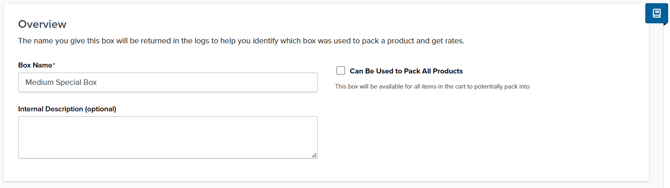
- Create a new Pack According to Box Rules rule and assign those boxes.
- Link the rule to those products in your eCommerce settings.
- For other products, define boxes with “Can Be Used to Pack All Products” set to Yes.
Why it helps: Gives flexibility for general products while keeping control over items that need specific packaging.
Assign a Default Packing Rule with Specific Boxes
Set up:-
Define boxes in ShipperHQ and keep “Can Be Used to Pack All Products” unchecked or marked as No in csv.
-
Create a new Pack According to Box Rules rule named All Products.
-
Assign your chosen boxes and save.
- No need to assign in your ecommerce platform; ShipperHQ will use these boxes by default.
Why it helps: This acts as a fallback, ensuring products without rules still get packed accurately based on box dimensions.
Pack With Any Available Box
Set up:-
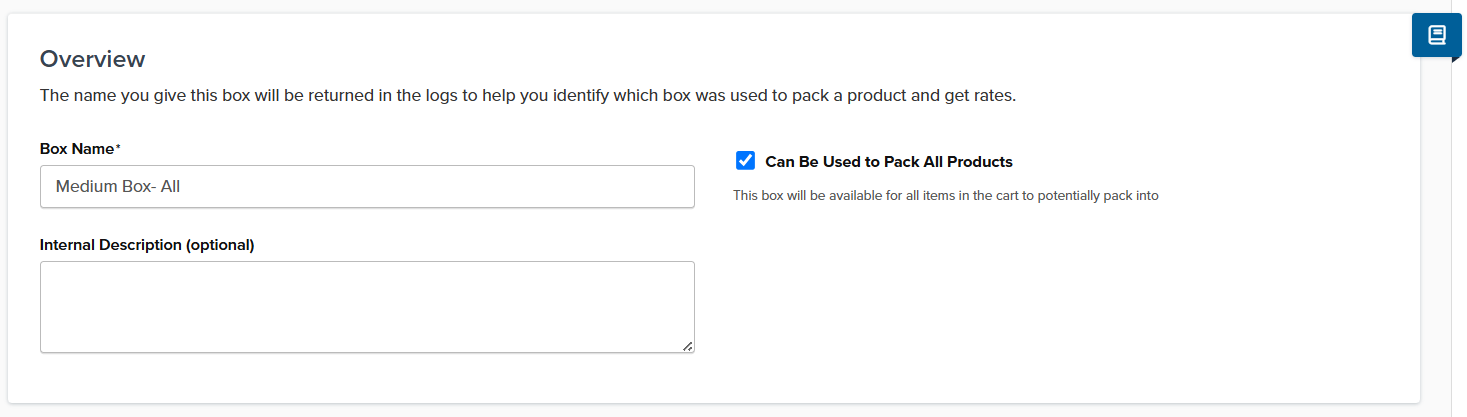
Define boxes in ShipperHQ and keep “Can Be Used to Pack All Products” checked or as Yes in the csv.
-
No rule is needed. ShipperHQ automatically uses any available box.
Why it helps: Ideal for stores with products that can fit into multiple box types. It gives the Best-Fit algorithm full flexibility to optimize packing and keep shipping costs low.