
Table of Contents
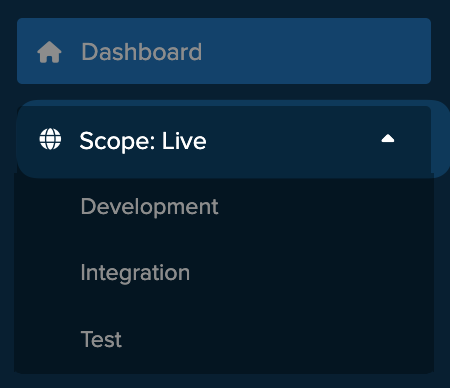
ShipperHQ includes four independent configuration environments called scopes. Each scope holds its own set of carriers, shipping rules, origins, zones, and other settings. When your website requests shipping rates, it pulls from whichever scope you've connected it to — so you can safely build and test a new configuration without affecting what shoppers see at checkout.
Requirements
- Scopes are only available for Magento 2 stores
- One-click scope copying and backup tools require an Enterprise plan. See Copy & Manage Scopes on Enterprise for details.
What Are Scopes?
A scope is a complete, standalone shipping configuration. You can think of it as a separate workspace: the carriers, rules, and settings you configure in one scope have no effect on any other scope unless you copy them deliberately. (There are exceptions -- see What Scopes Control.)
Each ShipperHQ account has four scopes:
- Development — typically used for early-stage builds and exploratory configuration
- Integration — commonly used for staging or QA environments
- Live — typically connected to your production store
- Test — commonly used for testing changes before pushing them live
All four scopes are functionally identical; the names are conventions, not enforced behavior. These names provide a shared language for teams coordinating across environments.
Scopes cannot be customized. Scope names are fixed, and new scopes cannot be added.
What Scopes Control
Most configuration settings in ShipperHQ are scope-specific — changes you make in one scope have no effect on any other. If you configure carriers and rules in Test, those settings do not exist in Live until you copy them there. The two exceptions are settings found in My Account › Global Settings, and Advanced Features: any global setting or Advanced Feature you enable or change applies to all four scopes immediately, including Live.
Copying configuration between scopes is a manual process for most settings. The table below shows which settings are scope-specific and how each can be moved to another scope. Items marked CSV can be exported from one scope and re-imported into another. Items marked Manual must be recreated by hand in the destination scope.
| Setting | How to copy to another scope |
|---|---|
| Websites | CSV export/import |
| Origins | CSV export/import |
| Carriers | Manual |
| Shipping Rules | Manual |
| Shipping Zones | CSV export/import |
| Table Rate tables | CSV export/import |
| Shipping Groups | CSV export/import |
| Box definitions | CSV export/import |
| Filters | CSV export/import |
| Customer Groups | CSV export/import |
For step-by-step instructions on the manual export/import process, see Duplicating a Scope Configuration. Enterprise plan users can skip most of this with one-click copying — see Copy & Manage Scopes on Enterprise.
Connecting Scopes to Your Website
Each scope connects to a specific website environment via the scope setting in your Magento extension configuration. This is how ShipperHQ knows which set of rates to return for a given storefront request.
If you're unsure which scope your website is connected to, check the Environment Scope setting in your extension before making configuration changes. See Configure the ShipperHQ Adobe Commerce/Magento 2 Extension for details.
Use Cases
Development Process
The most important purpose of scopes in ShipperHQ is to support a best-practice development lifecycle. By making changes to your configuration in the Test scope and testing those on your dev site, you can ensure you've ironed out any potential issues before pushing those changes to your live site under the Live scope.
For example: configure new carriers and shipping rules in the Test scope, connect your staging site to Test, validate rates, and then copy the configuration to Live when it's ready for production.
Alternate/Seasonal Configurations
If your shipping differs at certain times of year — holiday promotions, carrier changes, blackout dates — you can maintain two full configurations simultaneously in separate scopes. When it's time to switch, you update the scope connection rather than rebuilding your setup.
FAQ
Why do scopes have fixed names if they're functionally identical?
The fixed names exist to provide a consistent vocabulary for development teams who need a shared way to refer to environments. The names aren't enforced by the platform — you can use any scope for any purpose. If you have specific questions about how to structure your scope setup, contact ShipperHQ support for recommendations.
I changed a setting and it affected my live site. What happened?
The most likely cause is that the change was made to an Advanced Feature. Advanced Features apply across all scopes. Check My Account › Advanced Features to see if a global setting was modified.
Another possibility: your live website may be connected to a scope you didn't intend to edit. Check the scope setting in your Magento or Zoey extension to confirm which scope your live site is pointing to.
Does the Activity Log show which scope an action occurred in?
The Activity Log combines activity across all scopes and does not indicate which scope a specific action occurred in.