
Table of Contents
- Setting Up Your Origins
- Configuring Carriers
- Shipping Groups, Zones, and Rules
- Testing Your Rates
- Connecting Your Store
- What's Next
Whether you're dealing with multiple warehouses, products that need special handling, or simply want accurate real-time rates at checkout, ShipperHQ gives you the tools to build a shipping experience that fits your business.
This guide walks you through the essential setup steps. By the end, you'll have a working configuration — with origins defined, carriers ready, and rates returning at checkout.
Don't have an account yet? Start a free trial or log in to get started.
Speed through setup! When you start your trial, you'll answer questions that help configure your ShipperHQ dashboard instantly. Those settings can be updated at any time.
Setting Up Your Origins
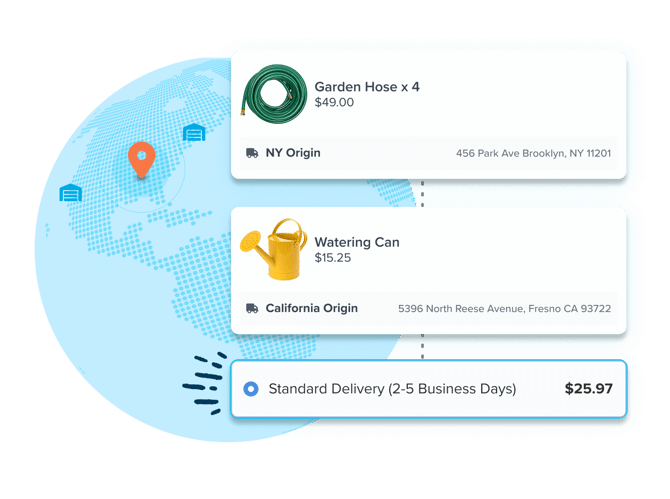
Your origin is where you ship from — a warehouse, retail store, or fulfillment center. ShipperHQ creates a default origin during your trial setup; you'll need to update it with your actual address and assign carriers to it.
Quick Steps:
- Go to Origins, edit the default origin or click New+.
- Give it a clear name — something like "Main Warehouse" or "Austin Location".
- Enter your complete ship-from address. (Accuracy matters here, especially for live-rate carriers!) Save your changes.
Once you've set up carriers, come back to assign them to this origin.
Adding Carriers
Carriers are the shipping services your customers see at checkout — like UPS Ground, FedEx Express, freight options, or flat rates. ShipperHQ supports two types:
- Live Rate Carriers — real-time rates pulled directly from your carrier account (UPS, FedEx, USPS, DHL, and 40+ others, including LTL freight carriers)
- Custom Rate Carriers — rates you define yourself (flat rates, table rates, free shipping, in-store pickup, and more)
Browse all available options in the Carrier Marketplace in your ShipperHQ Dashboard.
Quick Steps:
- Go to Carriers in your ShipperHQ Dashboard and click New+.
- Choose your carrier type — Live Rate Carrier or Custom Rate Carrier — and select your carrier.
- For live-rate carriers, enter your account credentials to access your negotiated rates. For custom carriers, define your shipping methods and rates.
- Select which shipping methods to show customers and save. You can also set up different configuration options.
For more detailed instructions on carrier setup, see Getting Started with Carriers,
Shipping Groups, Zones, and Rules
With origins and carriers configured, you have working rates. Shipping groups, zones, and rules are optional — use them to control which rates appear and when.
-
Shipping groups label products (fragile items, hazmat, freight)
-
Shipping zones define destinations (your home state, international regions)
-
Shipping rules combine conditions into actions (free shipping over $100 to California, surcharge for fragile items, hide overnight for hazmat).
Groups and zones are the building blocks; rules are where you use them.
Shipping Groups (Optional)
Shipping groups are labels you create in ShipperHQ and assign to products in your ecommerce platform. They tell ShipperHQ that certain products need different treatment — a "Fragile Items" group can trigger a surcharge rule, a "Hazmat" group can restrict which carriers appear, an "LTL Freight" group can carry a freight class for accurate LTL quotes.
ShipperHQ assigns all products to a default group automatically. You'll want to create groups if you need rules or packing behavior to target specific products.
- Go to Shipping Rules › Shipping Groups, click New+, and name the group.
- In your new shipping group, explore the Optional and Advanced tabs to configure its behavior — including rate separation, freight class assignment, and packing rules.
For the full range of shipping group settings and how to assign groups to products in your platform, see How to configure Shipping Groups.
Shipping Zones
Shipping zones are geographic definitions — countries, states, cities, or postal codes — that you can reference in rules and carriers. Use them when you need different shipping behavior by destination: free shipping to your home state, USPS for continental US, or restrict hazmat from Alaska and Hawaii.
Zones aren't required to get rates, but they're a prerequisite for any rule that needs to act on destination.
- Go to Shipping Rules › Shipping Zones, click New+, and name the zone.
- Define its geography — countries, states, cities, or postal codes — and save.
For detailed zone configuration options and examples, see How to configure Shipping Zones.
Shipping Rules
Shipping rules are where groups and zones come together. A rule has two parts: an action (what happens — offer free shipping, add a surcharge, hide a method) and one or more conditions (when it happens — a cart total, a product group, a destination zone).
Common shipping rules include:
- Free shipping for orders over a certain amount
- A surcharge for oversized or fragile products
- Hiding overnight shipping when certain items are in the cart
- Restricting certain carriers to specific regions
Rules reference your carriers, groups, and zones — so those need to exist before a rule can use them. Follow these quick steps to build a shipping rule:
- Go to Shipping Rules and click New+.
- Choose an action — what happens (offer free shipping, add a surcharge, hide a method) — and select the carrier methods it applies to.
- Add conditions to scope when the rule fires — by cart total, shipping group, zone, or a combination — and save.
Explore different types of shipping rules commonly used by businesses.
For a full walkthrough of actions, conditions, and common use cases, see Creating Shipping Rules.
Testing Your Rates
Before going live — and after any configuration change — use the Test Your Rates tool in your ShipperHQ Dashboard to verify rates are appearing correctly.
Enter a destination and select products to simulate a checkout and see what your customers would see — it's faster than placing test orders and catches configuration issues early.
For more on interpreting results and testing edge cases, see How to Test Your Rates in ShipperHQ.
Connecting Your Store
To get ShipperHQ rates at checkout, you need to connect your ecommerce platform to your ShipperHQ account. The connection process varies by platform — some connect automatically through an app installation, while others require you to enter API credentials manually.
BigCommerce and Shopify: The ShipperHQ app connects your store automatically during installation. Once connected, you'll need to configure product attributes and other settings in your platform so ShipperHQ can access the data it needs for accurate rates.
Magento, WooCommerce, and other platforms: For these platforms, your ShipperHQ account and your store are configured independently. When you're ready to connect, you'll retrieve your ShipperHQ API credentials and enter them into your platform's ShipperHQ extension or plugin settings.
- How to install ShipperHQ on Magento 2
- How to install ShipperHQ on WooCommerce
- How to Connect ShipperHQ to Your Website — covers all other platforms
Next Steps
You've got the basics in place. From here, you can keep refining your setup.
In the dashboard's top right, "My Account" holds all global, profile, billing, and plan settings for your account.
- Explore Global Settings to control default behaviors and edge cases
- Set up Billing to manage your ShipperHQ account and payments
You can also add advanced features based on your business needs. Each ShipperHQ plan includes a set number of advanced feature slots — you choose which features to enable based on what matters most to your business. Check your available slots in your Dashboard or contact ShipperHQ to add more.
Popular advanced features include:
- Dimensional Packing — calculate shipping costs based on box dimensions and packing efficiency
- Delivery Date & Time — let customers choose delivery windows at checkout
- In-Store Pickup — offer pickup options at your retail locations
- Multi-Origin Shipping — ship from multiple warehouses with smart routing
- LTL Freight Carriers — configure freight shipping with class-based rating
See the full list in Advanced Features in ShipperHQ.
Additional Resources
- Platform Configuration
- Getting Started with Carriers
- How to configure Origins
- How to configure Shipping Zones
- Creating Shipping Rules
- Advanced Features in ShipperHQ
- Contact ShipperHQ Support